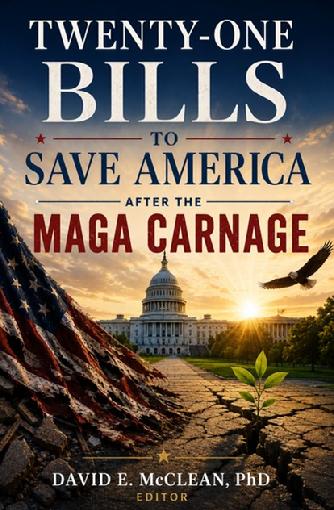
Introduction
After the Carnage: Why These Bills and Why Now
The referenced bills were not prepared under normal circumstances. We are approaching the end of a “phase” in the American experiment. We will have a better grasp of the state of the republic soon after the 2026 mid-term elections, although the mid-terms alone will not be definitive.
I give the word “phase” the meaning that W.E.B. Du Bois gave it in The Souls of Black Folk. There the term was used in its older, broader sense, i.e. an aspect, manifestation, or dimension of a larger reality—not a chronological stage. Du Bois referred to “the problem of the color line” as a phase, or manifestation, of a larger, transmutable problem or condition. While “the problem of the color line” has a good deal to do with the current and regrettable state of American politics (and that is, perhaps, an understatement), the phase of the American experiment that I am referencing is broader, deeper, and more complex than that problem, and it involves how Americans understand political economy, international relations, the natural environment, and the role of the country in the community of nations.
Drafting the bills was not conceived as an academic exercise or project, nor are the bills a collection of legislative thought experiments. Rather, the bills emerged from a conviction that the constitutional system of the United States has entered a period of profound vulnerability—one in which many of the assumptions that guided American government for generations can no longer safely be taken for granted. The draft bills collected herein are offered as responses to that reality.
Some readers will regard the proposals as bold. Others will regard them as controversial. A few may consider them radical. Such reactions are understandable. Yet the circumstances that gave rise to these proposals are themselves extraordinary. Extraordinary circumstances often require the reexamination of institutions, assumptions, and legal structures that, under more stable conditions, might otherwise remain unquestioned. Unfortunately, very few things can remain unquestioned—or simply assumed. Perhaps in the future that will change, though more than likely it will not.
This collection proceeds from a simple proposition: democracies do not generally collapse because constitutions disappear. They deteriorate because constitutional norms cease to function as intended. Formal institutions remain. Elections continue. Courts still convene. Legislatures still meet. Yet the practical restraints that once prevented abuses of power become increasingly ineffective. The appearance of constitutional order remains even as its substance is gradually hollowed out. Many observers across the ideological spectrum have warned that the United States may be approaching precisely such a moment. Thus, it may be entering a new phase.
Among the most notable recent contributions is Barbara McQuade's book, The Fix, which discusses the nature, forms, and enactments of corruption across the federal government, largely emanating from the Oval Office. Similarly, Steven Levitsky and Daniel Ziblatt argued in How Democracies Die that democratic systems rarely collapse through dramatic coups. More often, they erode incrementally through the weakening of institutions, the normalization of misconduct, and the gradual concentration of power in individuals and movements unwilling to accept meaningful limits upon their authority.
Democracies do not generally collapse because constitutions disappear. They deteriorate because constitutional norms cease to function as intended.
The concerns explored in these and many other works are not theoretical. They are rooted in events that have occurred in the United States during the past decade.
The rise of the Trump-MAGA movement (a radical rather than a conservative movement, despite the party that it has claimed and infected) has generated one of the most significant constitutional stress tests in modern American history. Its defenders view it as a populist corrective to entrenched political institutions. Its critics view it as a movement characterized by hostility toward constitutional constraints, expertise, professional administration, independent oversight, and pluralistic democracy itself. At worst, perhaps, it is an ethnonationalist movement, one that even flirts quite openly with the establishment of a state religion, Christianity. (Whose version of Christianity remains somewhat of a mystery, once one surveys the most prominent MAGA leaders, who range from cultural Christians, to cultish Catholics, to fundamentalist Protestants).
The legislative proposals are premised upon the belief that the Trump-MAGA coalition and important elements of its associated political, media, financial, and ideological networks have exposed serious weaknesses in American institutions and norms. Those weaknesses were not created by Donald Trump. Most predated him. Yet his rise revealed them, accelerated them, and in many cases exploited them.
The purpose of the collection is not merely to criticize a political movement. Political criticism alone accomplishes very little. The purpose is instead to ask a more difficult question: What legal and institutional reforms would be necessary if one concluded that existing safeguards have proven inadequate?
That question animates every bill.
The reader will quickly notice that these proposals vary significantly in subject matter. Some concern presidential authority. Others concern administrative agencies. Others address conflicts of interest, corruption, foreign influence, artificial intelligence, campaign finance, federal personnel systems, civil rights enforcement, institutional restoration, ethics, accountability, and democratic governance. Despite their diversity, however, they share a common premise. The premise is that modern American government contains too many areas in which constitutional expectations depend upon voluntary compliance rather than enforceable legal obligations.
Throughout much of American history, informal norms compensated for this weakness. Presidents generally released tax returns. Officials generally avoided obvious conflicts of interest. Agencies generally respected scientific and professional expertise. Inspectors General generally enjoyed a measure of independence. Public officials generally avoided conduct that would plainly undermine confidence in democratic institutions. Yet norms are effective only when political actors choose to honor them. When norms collapse, the question becomes whether legal institutions possess sufficient resilience to preserve constitutional government without them.
The bills represent one possible answer.
Some readers will object that legislation cannot solve fundamentally political problems. That criticism contains considerable truth. Laws cannot create civic virtue. Statutes cannot manufacture wisdom. Regulations cannot eliminate corruption, dishonesty, extremism, or demagoguery.
Nevertheless, laws shape incentives, establish boundaries, alter calculations, and influence behavior. The history of democratic reform demonstrates that legal structures matter. Anti-corruption laws matter. Civil-service protections matter. Transparency requirements matter. Independent oversight matters. Ethics laws matter. Electoral rules matter. It is true that good institutions cannot guarantee good outcomes. Yet weak institutions virtually guarantee bad ones. For that reason, the principal objective is institutional rather than partisan. Its concern is not merely who occupies power today, but rather its concern is who may occupy power tomorrow. Any authority that can be abused by one administration can be abused by another. Any loophole available to one political faction is available to its opponents once power changes hands. Any constitutional weakness tolerated for temporary advantage eventually becomes a permanent vulnerability.
A recurring theme throughout the collection is therefore reciprocity. Readers should ask themselves a simple question while evaluating each proposal: Would I support this institutional safeguard if my political opponents controlled the government?
If the answer is no, caution is warranted.
If the answer is yes, the proposal may deserve serious consideration, even if the specific draft is flawed. On that point, the bills are not offered as a final legislative program. They are offered as a starting point for discussion and will likely be discussed alongside others. Indeed, some of the proposals contained herein are intentionally drafted in aggressive terms. That decision was deliberate. Too often, reform proposals are weakened before debate even begins. Advocates negotiate against themselves. They anticipate objections, dilute their proposals, eliminate controversial provisions, and ultimately present reforms already stripped of much of their practical effect. I have chosen not to follow that approach, in most instances.
Several bills press constitutional boundaries. Some likely contain provisions that courts would reject in their present form. Others would require substantial revision before enactment. Still others may prove politically unattainable. That is not a defect of the project. It is one of its purposes.
Each bill therefore contains not only proposed statutory language but also a constitutional and administrative law analysis. Those analyses, which are typical, identify vulnerabilities, legal obstacles, implementation concerns, separation-of-powers questions, due-process issues, First Amendment concerns, nondelegation problems, federalism issues, and other matters likely to arise during legislative consideration. The analyses are intended to perform the work ordinarily undertaken by congressional counsel, committee staff, executive agencies, litigants, scholars, and courts.
The reader should therefore understand the bills and analyses as functioning together. The bill represents the objective. The analysis represents reality. The distance between the two reveals the work that would be required to transform aspiration into law. In this respect, the collection mirrors the actual legislative process.
No significant reform emerges from Congress exactly as originally proposed. Bills are amended. Compromises are negotiated. Constitutional concerns are addressed. Administrative details are refined. Political coalitions are assembled. Judicial precedents are considered. Legislation evolves. The bills presented here are therefore best understood as opening positions in an ongoing constitutional conversation. They are designed to provoke discussion concerning what democratic self-government requires at a moment when many Americans increasingly doubt the capacity of existing institutions to protect it. Underlying every proposal is a larger question: What does it mean to preserve a constitutional republic in an age of democratic erosion?
The answer cannot be nostalgia or magical thinking. The answer cannot be passive faith that institutions will somehow repair themselves. Nor can the answer be resignation. The American constitutional tradition has never been static. It has repeatedly adapted to crises that earlier generations could scarcely imagine. Reconstruction, the Progressive Era, the New Deal, the Civil Rights Movement, Watergate reforms, and post-Cold War instit utional changes each reflected efforts to reconcile inherited constitutional principles with emerging realities.
Our generation faces its own set of challenges. Some are technological. Some are political. Some are economic. Some are cultural. Many are constitutional.
Artificial intelligence, disinformation, political polarization, concentrated wealth, attacks upon expertise, foreign influence operations, environmental instability, institutional distrust, and the normalization of corruption all present challenges that existing legal frameworks were not designed to address. Whether one agrees with every proposal is ultimately beside the point. No reader should.
The purpose of democratic deliberation is not unanimous agreement. It is thoughtful disagreement conducted within a constitutional framework. If these proposals encourage serious reflection about the future of democratic institutions, they will have served their purpose. If they generate debate about how constitutional government should respond to emerging threats, they will have served their purpose. If they inspire better proposals, more carefully crafted legislation, and more durable reforms, they will have served their purpose.
The stakes could hardly be higher. The central question facing the United States is not whether constitutional government will survive the challenges of the present moment. Constitutions are remarkably durable documents. The question is whether constitutional government will remain sufficiently robust to protect liberty, accountability, competence, equality before the law, and democratic self-government in the decades ahead.
The twenty-one bills you will find at the website linked above, prepared by one concerned citizen, constitute one attempt to answer that question. They are offered not as final answers, but as invitations to begin the work, or to join others doing similar work.
Very likely, twenty-one more are needed.
D.E.M.
Long Island, New York
Summer 2026
|